Could changing your glassware actually alter the chemistry of your whisky? It’s not magic-it’s physics. While collectors obsess over cask finishes and age statements, the vessel itself plays a silent but decisive role in how aromas rise, how temperature shifts, and how the liquid feels on the palate. The shape, material, and craftsmanship of a glass don’t just complement the spirit-they actively shape the experience. And when it comes to precision, few materials match the optical clarity and thermal stability of fine crystal.
The essential features of a high-performance whisky vessel
Not all glassware is built to reveal a whisky’s full character. A true tasting vessel does more than hold liquid-it acts as a tool for sensory analysis. The best designs balance scientific principles with artisanal refinement, ensuring every pour delivers maximum aromatic concentration and tactile pleasure. This is where crystal outperforms standard glass, thanks to its unique structural properties and the precision with which it can be shaped.
Technical precision in crystal craftsmanship
The way a crystal glass is made affects how you perceive the spirit. Hand-cut facets, for instance, aren't just decorative-they enhance light refraction, allowing you to study the legs or tears of the whisky as it clings to the glass. These visual cues offer insight into viscosity and alcohol content. More importantly, high-quality crystal has a higher density, which stabilizes temperature better than regular glass. That means your dram warms more slowly, preserving its intended profile. For those seeking to truly appreciate the subtle nuances of a rare malt, selecting a dedicated whisky tasting glass remains the essential step in the connoisseur's journey.
- Refractive index for enhanced clarity and brilliance
- Ultra-thin rim for seamless sipping and improved lip feel
- Optimal bowl diameter to promote controlled aeration
- Lead-free crystal meeting modern safety and durability standards
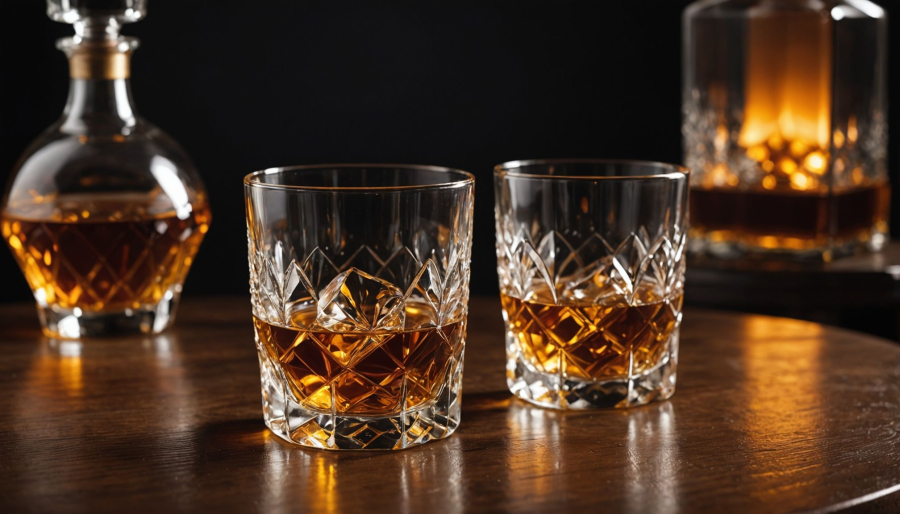
Comparing geometry: Which shape suits your dram?
The shape of a glass isn’t just about style-it’s about function. Each design steers the spirit toward different sensory outcomes, whether amplifying delicate floral notes or balancing high alcohol burn. The ideal choice depends on how you drink your whisky and what aspects of the spirit you want to highlight.
The science of the tulip vs. the tumbler
A tulip-shaped glass, like the Glencairn, narrows at the top to trap volatile aromatic compounds, directing them toward the nose. This design is ideal for nosing complex single malts. In contrast, the wide opening of a tumbler allows rapid evaporation, which can accentuate alcohol heat but reduce aromatic nuance. The heavy base of a rocks glass adds comfort and stability, especially when serving over ice, but sacrifices some aromatic precision.
How mouth-blown glass affects the palate
Machine-made glasses often have thicker rims, which can disrupt the flow of liquid and create an uneven mouthfeel. Mouth-blown crystal, however, allows for an ultra-fine, smooth rim that guides the whisky directly onto the tongue with precision. This subtle difference enhances the perception of texture and balance-critical when evaluating high-proof or cask-strength expressions.
Maintenance and longevity of fine crystal
Proper care ensures crystal retains its brilliance over time. Hand-washing with mild detergent and a soft cloth prevents micro-scratches. Avoid extreme temperature shocks-never pour hot water into a chilled glass. Store upright or with protective padding between pieces. With care, crystal glassware can last for decades, improving with each use.
| Style | Primary Use | Aromatic Intensity | Comfort Level | Ideal Spirit Type |
|---|---|---|---|---|
| Glencairn | Nosing & neat tasting | High | Moderate | Single malt, cask strength |
| Copita | Professional evaluation | Very High | Low | Blends, aged expressions |
| Neat | Alcohol reduction + aroma | High | High | High-proof spirits |
| Tumbler | On the rocks or mixed | Low | Very High | Bourbon, rye, blends |
Unlocking the aromatic spectrum through crystal density
Crystal isn’t just about elegance-it’s a functional medium that interacts with the spirit on a molecular level. The material’s density and purity influence how aromas are released and how temperature is retained, two factors that define the quality of a tasting experience.
Thermal conductivity and spirit temperature
Thicker crystal walls insulate better than thin glass, slowing down the rate at which the whisky warms in your hand. This is crucial for cask-strength bottlings, which often benefit from a slight warming to open up, but can become harsh if they heat too quickly. The controlled heat transfer of crystal allows the drinker to guide this evolution deliberately, sip by sip.
The role of clarity in sensory evaluation
To assess a whisky’s true color-its amber, gold, or russet hues-you need a completely neutral canvas. Impurities or greenish tints in low-grade glass can distort perception. Premium crystal is meticulously refined to be colorless and perfectly transparent, offering an unfiltered view of the liquid. This clarity supports accurate evaluation, whether you're judging age, cask influence, or filtration methods.
From the workshop to the bar: A legacy of excellence
The finest crystal glassware bridges centuries of craftsmanship with modern sensory science. While the tools have evolved, the core techniques-mouth-blowing, hand-cutting, annealing-remain rooted in tradition, adapted to meet today’s standards of precision and durability.
Heritage techniques in modern spirits service
Mouth-blowing allows for greater control over wall thickness and bowl symmetry, resulting in a lighter, more balanced glass. When combined with hand-finishing, this method produces rims so fine they seem to disappear on the lips. These techniques, passed down through generations, are now applied to designs specifically engineered for whisky tasting-where every curve serves a sensory purpose.
Sustainability in crystal production
Modern crystal makers are rethinking resource use without compromising quality. Some workshops now rely on electric furnaces to reduce emissions, while others recycle offcuts into new batches. The goal is to preserve the weight, clarity, and resonance of traditional crystal while minimizing environmental impact. It’s a delicate balance-like the spirit it serves.
Common inquiries from whisky enthusiasts
Does lead-free crystal actually change the chemical profile of the whisky?
No evidence suggests lead-free crystal alters the chemical composition of whisky. Modern formulations use alternative minerals like barium or zinc to achieve density and clarity. These materials are inert and food-safe, preventing any interaction with the spirit. The change is in safety and durability, not flavor chemistry.
Is it acceptable to use a white wine glass as a temporary substitute?
Yes, a white wine glass can work in a pinch. Its tulip shape traps aromas similarly to a Copita or Glencairn. However, the bowl is often larger, which increases surface area and accelerates alcohol evaporation. This may dull subtle notes over time, but it remains a functional alternative.
Are stackable crystal tumblers the new standard for luxury bars?
Stackable designs are gaining traction in high-end hospitality for their space efficiency and durability. While traditionalists prefer free-standing glasses, modern stackable versions now use reinforced rims and precision engineering to preserve acoustic and sensory qualities, blending practicality with luxury.
How long should I let the whisky breathe in a crystal glass before drinking?
A few minutes is usually enough. Swirling the glass gently increases surface exposure, accelerating aeration. Most whiskies reveal their core profile within 2-3 minutes. Highly complex or closed expressions may benefit from 5-10 minutes, but overexposure can lead to alcohol dominance.
